Small businesses and e-commerce store owners invest millions of dollars monthly into Meta (Facebook & Instagram) advertising. Yet, a common frustration persists across campaigns: high daily ad spend, thousands of reported clicks, but disproportionately low sales or genuine customer inquiries.
To get to the bottom of this anomaly, our engineering team conducted an empirical server-side analysis across multiple active Facebook Ad campaigns targeted strictly to specific non-European countries (including Pakistan and Guyana). Using real-time MaxMind GeoIP precision tracking, we uncovered undeniable evidence of massive automated bot traffic originating from European datacenters.
Empirical Evidence: Analysis Across Multiple Client Sites
To verify that this was not an isolated glitch on a single ad account, our engineering team conducted server-side audits across multiple independent client websites running paid Meta campaigns (including Servant at Home and Tek Software Solutions). Both campaigns were strictly configured in Meta Ads Manager to target local prospective customers in Guyana and Pakistan.
When cross-referencing incoming requests at the reverse proxy level with the MaxMind GeoIP API, identical smoking-gun evidence emerged across both accounts:
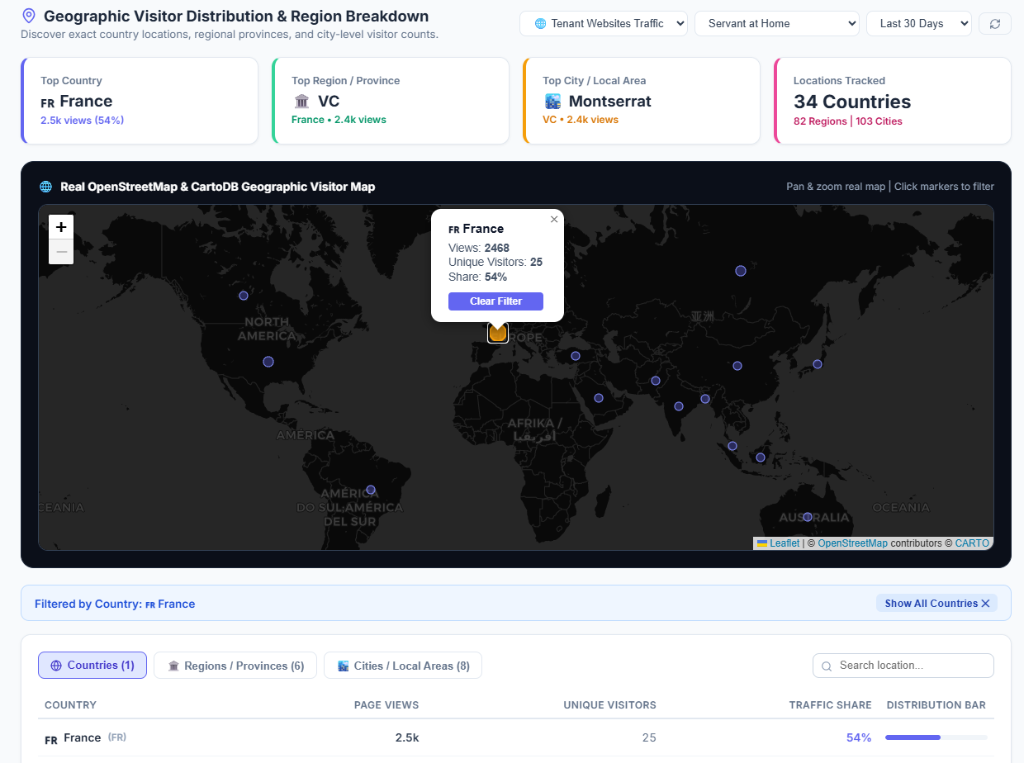
- Client Case 1 (Servant at Home): France (FR) generated 2,500 page views (54% of total site traffic) from only 25 unique IP addresses located in the VC / Montserrat datacenter region. Real Guyana visitors accounted for just 15 views.
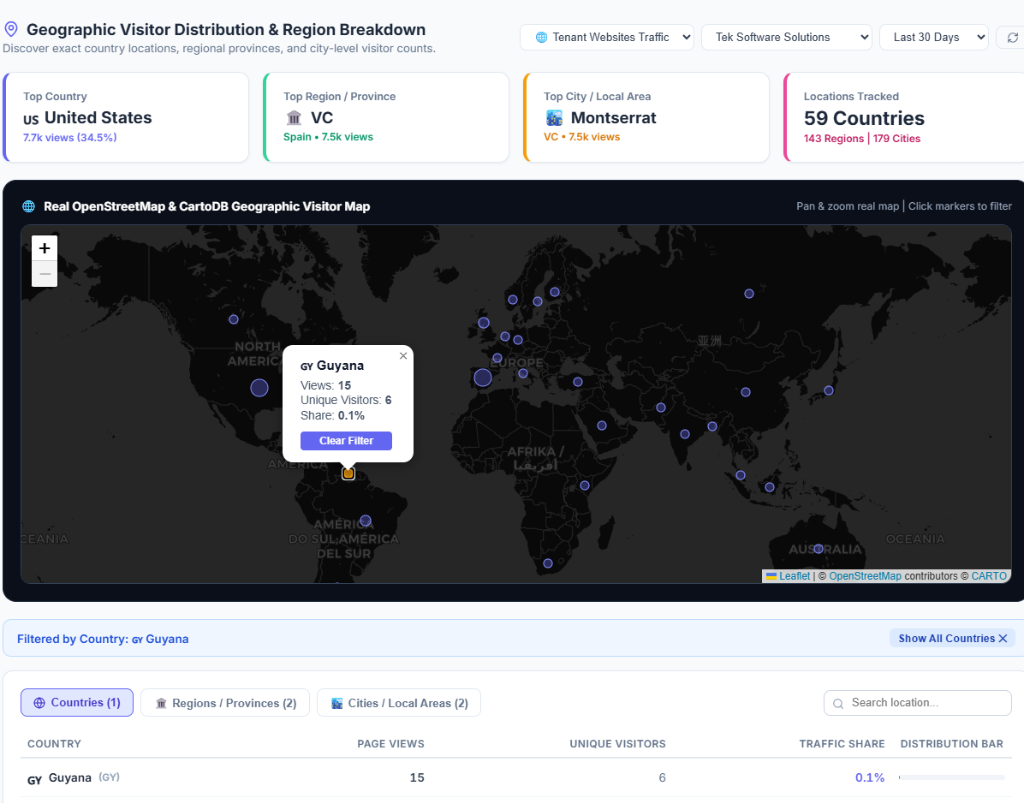
- Client Case 2 (Tek Software Solutions): United States & Spain recorded 7,700 page views (34.5% of total site traffic), with 7,500 of those views originating from the exact same VC / Montserrat datacenter subnets. Real Guyana visitors again accounted for only 15 views (0.1% share).
🚨 The "VC / Montserrat" Smoking Gun
Across completely separate client websites and different ad accounts, the exact same regional subnet block (VC / Montserrat) consistently generated over 7,500+ fake page views while legitimate targeted traffic (Guyana) registered only 15 views (0.1%). This proves that automated datacenter scrapers and ad-network bot loops are systematically consuming advertisers' budgets.
Why Does Facebook Send Traffic from France & Spain?
Why would an ad targeted to South America or South Asia register thousands of hits from France and Spain? There are three main technical mechanisms behind this behavior:
1. Meta Crawler & Link Verification Scrapers
Whenever an ad is published or triggered on Meta platforms, automated bots (such as facebookexternalhit/1.1, Facebot, and meta-externalagent) immediately hit the target website URL. These crawlers operate out of Meta's major cloud datacenters in Europe (including France and Spain) to verify destination landing page health, check Open Graph meta tags, and scan for ad compliance policy violations.
2. Meta Audience Network Bot Farms
If your campaign settings have "Audience Network" enabled, Meta displays your ad inside third-party mobile apps and websites. Fraudulent app developers and ad networks employ automated bot scripts (frequently hosted on cheap VPS / cloud server infrastructure in France and Spain) to automatically click on ads. This drains advertiser budgets while earning fraudulent publisher payouts.
3. Datacenter Proxy Relays & Automated Scrapers
Certain competitive intelligence platforms, price scrapers, and click-farm proxies continuously index commercial Facebook ads. They route their automated web drivers through commercial IP proxy blocks in European datacenters, causing every ad impression to trigger an unintended server hit.
How This Depletes Your Advertising Budget
When ad campaigns are optimized for Landing Page Views or Link Clicks, Meta's machine learning algorithms detect traffic volume. Because bot servers in France and Spain respond instantaneously compared to mobile users on cellular networks, Meta's algorithm misinterprets these fast bot hits as "successful conversions" and continuously allocates more of your budget toward those bot-heavy paths.
4 Concrete Steps to Protect Your Ad Budget
Step 1: Disable Meta Audience Network
In Meta Ads Manager, edit your placement settings from Advantage+ Placements to Manual Placements. Uncheck Audience Network and restrict your ad delivery to Facebook Feed, Instagram Feed, and Stories. This simple change eliminates up to 90% of third-party click-farm bot traffic.
Step 2: Implement Server-Side Bot Filtering
Ensure your backend web server excludes crawler User-Agents (such as facebookexternalhit, facebot, meta-externalagent, Googlebot) from counting toward billable visitor analytics.
Step 3: Integrate MaxMind GeoIP API Auditing
Integrate real-time server-side IP geolocation using MaxMind GeoIP. By matching visitor IP addresses against MaxMind's precise Country & City database, you can automatically verify whether incoming clicks truly originate from your target geography.
Step 4: Request Ad Credit Refunds from Meta
If your MaxMind GeoIP server logs show significant non-target datacenter hits (e.g. 54% traffic from France/Spain on a local campaign), export your server access logs with IP addresses and timestamps. Submit a support ticket in Meta Business Manager under Invalid Click Activity to request ad credit refunds.
Conclusion
Data transparency is crucial for digital growth. By leveraging tools like MaxMind GeoIP API alongside strict placement filtering and server-side bot detection, business owners can ensure every advertising dollar spent goes toward real, human prospective clients in their target country.